

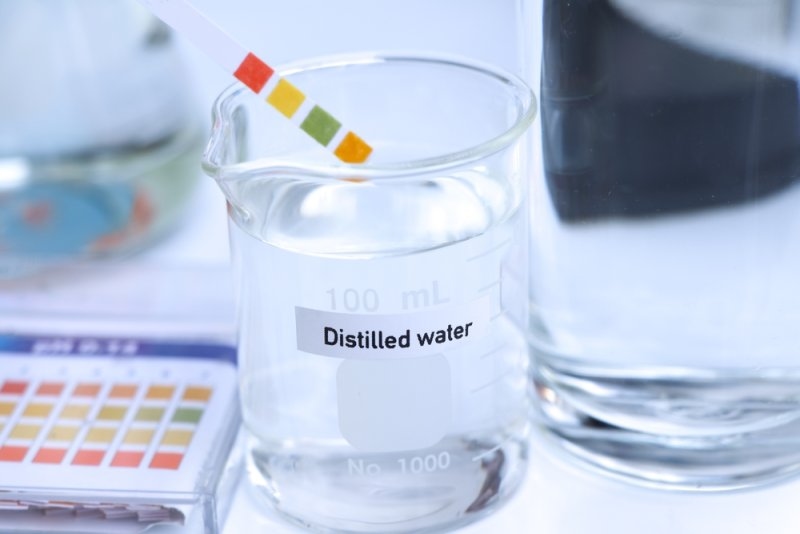
Ever stood in a store aisle staring at two bottles of water that look identical, with prices that aren't? You're not alone. Deionized and distilled water get mixed up all the time, even by people who use them daily. Here's the honest story on deionized water vs. distilled water, minus the lab jargon.
Purified water is simply water with the unwanted stuff taken out. That can happen through reverse osmosis, carbon filters, distillation, or deionization. So yes, both waters in this article are purified water. They just get clean in very different ways. If you're curious about one more member of the family, we've covered vapor distilled water too.
Deionized water, or DI water, is water with its dissolved ions removed. It passes through ion exchange resins, tiny beads that grab ions like calcium, sodium, and chloride and trade them for hydrogen and hydroxide. Those two join up to form water. What's left barely conducts electricity. The limit? It won't remove most bacteria, viruses, or organic compounds.
Distilled water is the old-school option. You boil water, and the steam rises while minerals, salts, and heavy metals stay behind. Cool that steam and it turns back into liquid. Most germs get left behind as well. Some volatile compounds can sneak through with the steam, though. Not sure how it stacks up against a regular filter? Our distilled water vs. filtered water guide covers it.
Here's the quick version of the difference between deionized and distilled water. One uses resin beads and chemistry. The other uses heat and condensation. That single change affects what each removes, what it costs to make, and where it works best. The table below lays it all out.
| Feature | Deionized Water | Distilled Water |
| Process | Ion exchange resins | Boiling and condensing steam |
| Removes | Dissolved ions and minerals | Minerals, metals, most microbes |
| May still contain | Bacteria, organic compounds | Some volatile compounds |
| Conductivity | Extremely low | Low, but slightly higher |
| Energy use | Lower | Higher |
| Best fit | Labs, electronics, cooling | Drinking, appliances, medical devices |
On ions, deionized water purity is hard to beat. Labs rate it by resistivity, and top-grade water can hit 18.2 megohm-centimeters, which is about as pure as water gets. Distilled water is clean too, but it may hold dissolved gases. Then again, deionized water can still carry bacteria. So which is purer? It depends on what you're trying to keep out.
Deionized water uses show up wherever leftover minerals would cause trouble. Its low conductivity keeps delicate gear safe, and test results honest. Factories and lab benches love it for that reason. Typical examples:
Distilled water uses are the ones you meet at home. Since boiling leaves scale-forming minerals behind, it keeps kettles and machines from clogging up, and it's generally fine to drink. You'll see it in:
The biggest deionized water benefits are control and consistency. Once the ions are gone, you know what you're working with, and your equipment stays cleaner. A few perks worth knowing:
Distilled water benefits are easy to spot at home. One step removes minerals and most microbes, and you don't need fancy equipment to get it. Here's what people like most:
Distilled water is generally safe to drink, though it tastes flat without minerals. Deionized water is a different story. It's made for equipment rather than people, and it can still contain bacteria, so it isn't usually recommended for regular drinking. Don't worry about lost minerals, since food covers most of that. Have health concerns? Ask your doctor.
Short answer: no. Both are purified water, but they clean up different things. Deionized water removes charged particles. Distilled water removes most solids and microbes through boiling. That means each one can contain something the other has removed. Some labs run distilled water through a deionizer to get the best of both.
Honestly, neither wins every time. The better one depends on your task, the contaminants you need gone, and how much water you'll use. It's easier than it sounds. Ask yourself a few quick questions, then use the guide below to match your answer.
Go with deionized water when ionic residue or conductivity could wreck your work. Think lab analysis, electronics rinsing, or spot-free cleaning. It also makes sense for big volumes, since deionizing systems can be cheaper to run than distillers. Just use it fresh, because it soaks up carbon dioxide from the air.
Choose distilled water when you want minerals and microbes gone in one go. It's the everyday pick for steam irons, humidifiers, and autoclaves, and it's the safer of the two for the occasional glass of water. If you use a lot, a home distiller saves you from hauling jugs.
A quick checklist saves you from costly mistakes:
Once you know the job, the choice gets simple. Deionized water wins on ionic purity and large-scale use. Distilled water wins on germs, appliances, and everyday needs. Match the water to the task, check your manual, and keep it sealed. Do that, and you'll avoid clogged machines, ruined results, and wasted money.
Usually, yes, but check your manual first. Deionized water prevents scale, though some brands recommend distilled because it's easier to find. Skip tap water, since minerals clog steam vents and shorten appliance life.
It doesn't spoil, but it can absorb carbon dioxide and pick up contaminants from open containers. Keep it in a clean, tightly sealed bottle away from sunlight, and use it within a few months.
Yes. A countertop distiller boils tap water and collects the condensed steam in a clean container. It's simple, but it uses electricity, and you'll need to descale the boiling chamber every so often.
With almost no dissolved minerals, deionized water tries to pull ions from anything it touches. Over time, that can corrode metals like copper and brass, so it pays to check material compatibility first.
Yes. Running distilled water through an ion exchange resin cartridge removes leftover ions and lowers conductivity even more. Many laboratories use this two-step method when experiments demand very high purity and steady, repeatable results.
This content was created by AI